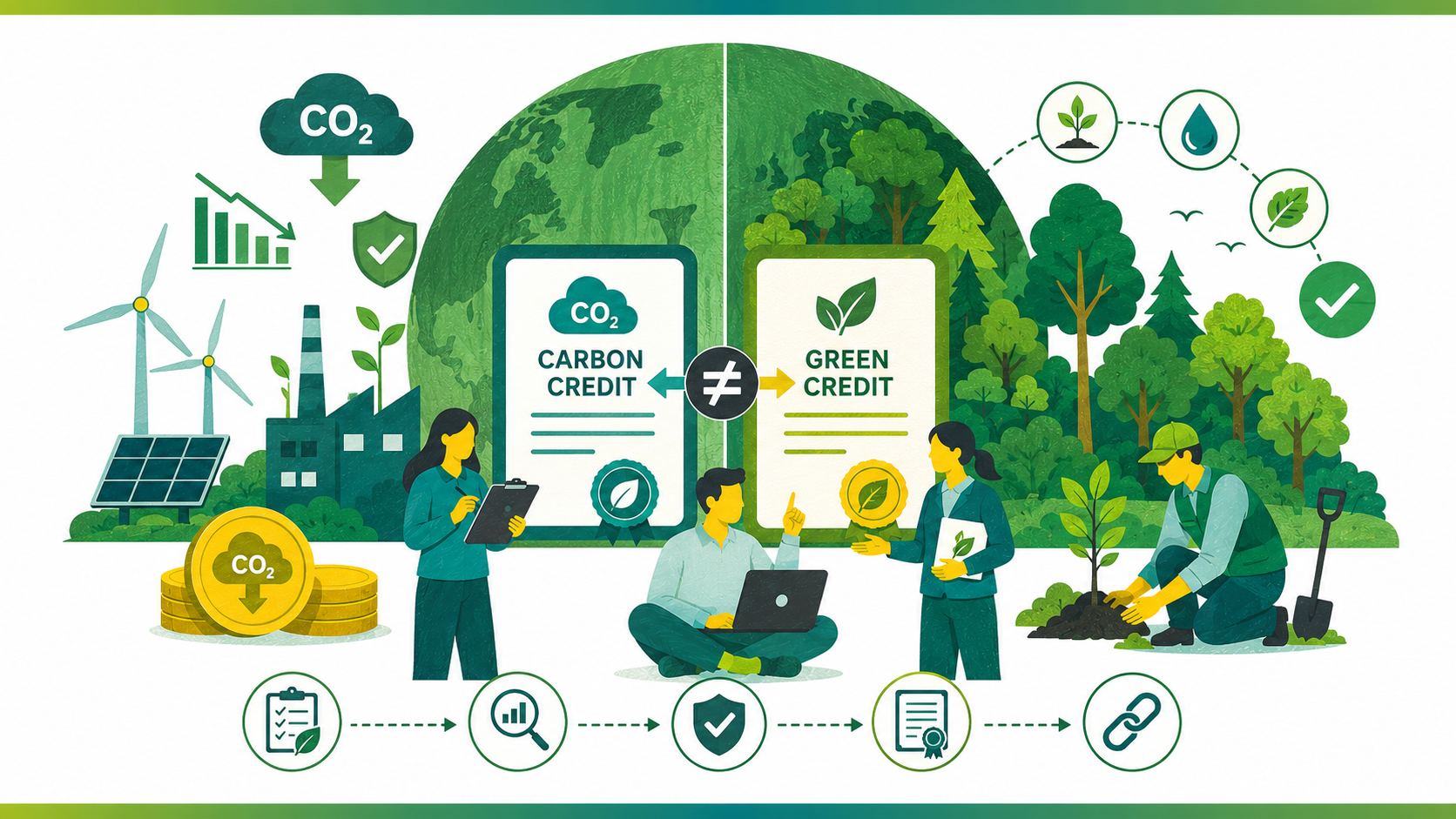
A carbon credit represents one tonne of carbon dioxide equivalent (CO₂e) that has been reduced, avoided, or removed from the atmosphere by a verified project. A green credit is an incentive issued for planting trees on degraded forest land under India's Green Credit Programme. They sound related. They are not, and conflating them leads to costly planning errors for CSR and ESG teams.
In Indian CSR and ESG conversations, carbon credits and green credits are frequently conflated, and the confusion is costly. The two instruments are created by different laws, administered by different agencies, cover different activities, and reward project owners in completely different ways. This article explains each instrument clearly, traces how India's carbon market has developed, and gives CSR and ESG teams a short diagnostic before they plan a credit-linked project.
What is a carbon credit?
A carbon credit is a certificate representing one tonne of CO₂e of greenhouse gas emissions that a project or an entity has reduced, avoided, or removed. The emphasis on "verified" is important: a credit does not spring into existence when a project claims to have reduced emissions; it is issued only after an independent body has confirmed the claim against a defined methodology.
Within that single unit, the market distinguishes two families of activity:
- Avoidance or reduction credits come from activities that prevent emissions that would otherwise have occurred: replacing coal-fired power with wind or solar, improving the energy efficiency of an industrial process, or capturing methane from a landfill before it reaches the atmosphere.
- Removal credits come from activities that draw existing CO₂ out of the atmosphere: afforestation, mangrove restoration, direct air capture, or enhanced weathering. Removal credits currently carry a growing market premium because they address stock, not just flow.
A common misconception is that project owners create their own credits. They do not. In every credible system, credits are issued by the governing standard or authority after independent third-party verification. The project developer can register a project, monitor its performance, and commission verification, but the credit itself is issued by the registry or regulator, not the project.
Carbon credits change hands in two kinds of markets. Compliance markets are created by regulation: a government sets emission caps for industries and requires high-emitting companies to surrender credits equal to their emissions. The European Union ETS is the world's largest. Voluntary carbon markets operate without a legal mandate; buyers purchase credits to offset their own residual emissions or to meet self-set net-zero commitments.
How does the voluntary carbon market work?
The voluntary market is where most of the world's project-based credits are generated, and it is the model on which India's own offset mechanism is broadly patterned. Understanding its logic helps decode the Indian compliance system.
Independent standards run the system. The largest is Verra, whose Verified Carbon Standard (VCS) issues the Verified Carbon Unit (VCU). Gold Standard, the American Carbon Registry, and the Climate Action Reserve run similar programmes. Each standard publishes approved methodologies that specify how baselines must be set, how monitoring must be conducted, and what additionality tests apply. A project's emissions reductions are only as credible as the methodology used to calculate them.
A project moves through five stages:
- Project design. The developer prepares a project description using an approved methodology for that activity type, setting the baseline scenario and explaining why the project would not have happened without carbon finance.
- Validation. An accredited, independent Validation and Verification Body (VVB) audits the plan: is the baseline honest, is the additionality argument sound, are the monitoring protocols workable?
- Registration. The standard reviews the validated project and lists it on its registry. No credits exist yet.
- Monitoring and verification. The project runs and measures its actual results. A VVB then verifies that the claimed reductions occurred. For multi-year projects, this cycle repeats on a defined schedule.
- Issuance and retirement. Only after verification does the standard issue credits into the developer's registry account. When a buyer uses a credit to offset their emissions, it is permanently retired. Retirement is irreversible.
Two vocabulary points save practitioners real confusion. Validation checks the plan; verification checks the results; credits are only issued after verification. "Retire" means permanently cancel for the purpose of offsetting; a retired credit cannot be resold. These distinctions matter when reading a project's documentation or a corporate offset claim.
Above both market types sits the Paris Agreement's Article 6, which governs carbon trading between countries. Article 6.4, once operational, will create a UN-supervised mechanism that overlaps with voluntary markets. The first credits under the Article 6.4 mechanism were approved by the UN in late 2024, but the mechanism remains nascent. India has been cautious about authorising Article 6 transfers while its own domestic market is still establishing itself.
How does India's carbon market (the CCTS) work?
India's compliance carbon market rests on the Carbon Credit Trading Scheme, notified by the Ministry of Power in June 2023 under the Energy Conservation (Amendment) Act, 2022. The CCTS is a mandatory, intensity-based trading scheme designed to price carbon domestically and progressively tighten emission targets across energy-intensive industry.
The scheme's unit is the Carbon Credit Certificate (CCC), equal to one tonne of CO₂e. Four institutions run the system: the Ministry of Power sets the overall framework; the Bureau of Energy Efficiency (BEE) issues certificates and manages the national registry; the Grid Controller of India runs the registry infrastructure; and the Central Electricity Regulatory Commission (CERC) regulates trading on power exchanges.
According to the Ministry of Environment, Forest and Climate Change's release of 22 January 2026, the CCTS operates through two distinct mechanisms: the Compliance Mechanism and the Offset Mechanism.
The Compliance Mechanism applies to designated emission-intensive industries:
- The government has notified greenhouse gas emission intensity (GEI) targets for 490 obligated entities across seven sectors: aluminium, cement, chlor-alkali, fertiliser, iron and steel, paper and pulp, and petrochemicals and petroleum refining.
- Targets apply for the compliance years 2025-26 and 2026-27, measured against a 2023-24 baseline. They are intensity targets, meaning they are expressed as CO₂e per unit of production, not absolute caps. A plant can grow and still comply if it grows more efficiently than the target.
- The scheme takes a "gate-to-gate" view of a plant: direct emissions from fuel and processes (scope 1) plus emissions from purchased electricity (scope 2). Scope 3 emissions are excluded for now.
- An entity that beats its intensity target receives CCCs from the BEE. An entity that misses it must buy and surrender an equivalent number of CCCs. CCCs can be bought from over-performers on the power exchanges, or from registered offset projects.
- The penalty for non-compliance is an environmental compensation equal to twice the average CCC trading price for that year, applied to every tonne of excess emissions.
Emissions performance in both mechanisms is checked before any certificate is issued: reports must be verified by a carbon verification agency accredited by the BEE.
One status note matters as of mid-2026. The CERC issued its regulations for the purchase and sale of CCCs on 27 February 2026, clearing the last major regulatory hurdle. Trading had not yet begun on the exchange as of the date of this article, but the regulatory infrastructure is complete. The first round of intensity targets covering 2025-26 performance data will feed the first compliance cycle, and market participants expect trading to open in the second half of 2026.
How can a company outside the seven sectors earn carbon credits in India?
Through the CCTS Offset Mechanism, which is the part of the Indian carbon market most relevant to readers of this article. The Offset Mechanism is the route by which a company in, say, IT services, retail, hospitality, or manufacturing outside the seven obligated sectors can generate CCCs by running a verified emissions-reduction project.
The Offset Mechanism lets entities outside the compliance net register projects that reduce, remove, or avoid emissions, have those projects verified, and receive CCCs which they can then sell to obligated entities that need to cover shortfalls.
The eligibility tests are strict, and three of them decide most cases:
- Start date. The project must have commenced on or after 1 January 2025. Older projects cannot be brought in retrospectively. This is a hard boundary, not a guideline.
- Additionality. The reductions must go beyond business as usual; a project that would have happened anyway does not qualify. A solar plant installed entirely for commercial reasons, with no carbon finance component, will struggle to pass an additionality test.
- No double counting. The project must not be claiming credits under any other carbon market.
Registered projects follow a project cycle recognisably similar to the voluntary market's: design documentation against a BEE-approved methodology, validation by an accredited VVB, registration on the national registry, periodic monitoring and verification, and CCC issuance after each verified period.
The start-date rule deserves emphasis because it recurs across frameworks. India's credit systems are built to reward new action, not to monetise existing activity. This design choice has real implications for companies that have been running efficiency or renewable energy programmes for years: those programmes are not eligible for credits under the CCTS, regardless of how well documented they are.
What is a green credit?
A green credit is an incentive for environment-positive action, created by the Green Credit Rules, 2023, notified on 12 October 2023 under the Environment (Protection) Act, 1986. The Green Credit Programme (GCP) was designed to cover eight categories of activity:
- Tree plantation
- Water conservation
- Sustainable agriculture
- Waste management
- Air pollution reduction
- Mangrove conservation and restoration
- Ecomark labelling
- Sustainable buildings and infrastructure
In practice, only the first is operational. The methodology for tree plantation and eco-restoration of degraded forest land was notified and has since been revised (most recently in August 2025). The other seven categories remain dormant pending methodology development.
The programme is administered by the Indian Council of Forestry Research and Education (ICFRE), Dehradun, which manages the Green Credit Registry and Portal (greenredit.icfre.gov.in) and oversees the designation of verification agencies.
It is also worth knowing how the scheme has changed, because much of what circulates about green credits describes rules that no longer apply. The original methodology allowed credits to be traded on a green credit market and had a potential linkage to the carbon market. The revised methodology, notified on 29 August 2025, removed both features. Green credits earned from tree plantation are now non-tradable and non-transferable between unrelated parties.
How do you earn green credits in India?
The process runs land-first, not project-first, and this single fact determines what is and is not possible:
- The state lists the land. State Forest Departments identify degraded forest land parcels, verify them on the ground, and list them on the Green Credit Portal with the number of credits available (one credit per tree, if the planting succeeds).
- The applicant takes up a listed parcel. A company registers on the portal and applies for an available parcel. Restoration work is carried out on the listed land, not on land of the company's own choosing.
- Five years pass, and the trees must survive. Under the revised methodology, green credits can be claimed only after a minimum five-year period and only if the planted area achieves at least 40% canopy density. Survival, not planting, is the trigger.
- A designated agency verifies, then ICFRE issues. Verification is physical and outcome-based; the designated agency reports to ICFRE, which issues credits to the applicant's registry account.
Note what this sequence excludes. A plantation that is already in the ground cannot be brought into the programme, because the land must be listed by the state before any work begins. A company cannot nominate its own land. And credits flow only after five years of demonstrated canopy survival, not at planting.
We encountered this directly in our advisory work. A wind-energy company asked us to assess its ongoing plantation project in Tamil Nadu for green credit eligibility. The project was substantive, well-documented, and genuinely contributing to local ecology. It was also ineligible: the land had not been listed by the state forest department before work began, the plantation was already in progress, and the revised methodology had removed any path for retrospective registration. The company received an honest assessment and redirected its ESG reporting to acknowledge the environmental value of the project without crediting it under the GCP.
The practical lesson generalises. Participation in the GCP depends entirely on whether your state's forest department has listed parcels on the portal, and on whether you can commit to a five-year restoration programme on land you do not own. For many companies, this makes the GCP a less accessible route than it first appears.
What is the difference between carbon credits and green credits?
The two instruments differ on almost every dimension that matters to a practitioner:
| Dimension | Carbon credit (CCTS) | Green credit (GCP) |
|---|---|---|
| What one unit represents | 1 tonne of CO₂e reduced, avoided, or removed | 1 surviving tree on restored degraded forest land |
| Parent law | Energy Conservation (Amendment) Act, 2022 | Environment (Protection) Act, 1986 |
| Notified | June 2023 (Ministry of Power) | October 2023 (MoEFCC) |
| Administrator | Bureau of Energy Efficiency | ICFRE, Dehradun |
| Scope | GHG emissions only | Eight environment categories (only tree plantation live) |
| Routes in | Compliance targets (7 sectors) or offset projects (start on or after 01-01-2025) | Restoration of state-listed degraded forest parcels only |
| Who verifies | BEE-accredited carbon verification agencies | Designated agency, reporting to ICFRE |
| Time to first credit | Annual compliance cycle; offset projects credit over 10-year or 5+5+5-year periods | Minimum 5 years, subject to 40% canopy density |
| Tradable? | Yes, on power exchanges regulated by CERC | No. Non-tradable and non-transferable (except within a holding company group) |
| How value is realised | Sale of CCCs, or surrender against a compliance obligation | One-time exchange against compensatory afforestation, CSR requirements, or other prescribed uses |
| Linked to each other? | No. August 2025 revision ruled out carbon-market linkage for green credits. | No. |
The last row deserves emphasis because it reverses an earlier expectation. The GCP's original methodology had left the door open for linking green credits to the carbon market. The August 2025 revision closed that door. Green credits cannot be converted into CCCs or surrendered against carbon compliance obligations.
Both frameworks do share one design instinct: neither rewards the past. The CCTS offset mechanism admits no project that started before 1 January 2025. The GCP admits no plantation that was begun before the land was listed on the state forest department's portal. For teams hoping to retrofit existing CSR environment activities into a credit framework, both programmes will disappoint.
How do credits turn into money?
For carbon credits, value comes from a market. An obligated entity that overachieves its intensity target receives CCCs it can sell on power exchanges. A registered offset project developer receives CCCs it can sell to obligated entities. Price discovery happens on exchange. The CERC sets a price floor and forbearance (ceiling) band for each compliance cycle to prevent extreme volatility. The actual clearing price will be determined by supply and demand within that band.
For green credits, there is no market by design. The revised methodology makes plantation credits non-tradable and non-transferable between unrelated parties. A company holding green credits can exchange them against specific obligations: compensatory afforestation requirements under the Forest (Conservation) Act, against CSR spending requirements, or against other prescribed regulatory purposes that the government may notify. A company cannot sell them to another unrelated company for cash.
This is the sharpest practical difference between the two instruments. A carbon credit is an asset you may eventually sell on an exchange. A green credit is a regulatory instrument you may exchange against a specific obligation. The business case for each is entirely different.
What should a CSR or ESG team check before planning a credit-linked project?
The rules themselves imply a short diagnostic, and running it early prevents the most common dead ends:
- Which instrument actually fits. Emission-reduction activity (renewables, efficiency, methane capture, mangrove afforestation with carbon quantification) points toward the CCTS Offset Mechanism. Tree plantation on state-listed degraded forest land points toward the GCP. Conflating the two leads to projects designed for the wrong framework.
- The sequencing rules. Nothing already underway qualifies anywhere: offset projects must start on or after 1 January 2025 and must be registered before monitoring begins; GCP applications require state-listed land before any planting starts. Confirm the project has not yet begun before engaging.
- State availability, for green credits. Confirm on the Green Credit Portal that your target state has listed parcels. As of mid-2026, availability varies significantly by state. If no parcels are available in your geography, the GCP is not a practical option regardless of your ambitions.
- The time horizon. Green credits arrive after five years at the earliest, and only if canopy density reaches 40%. Offset project credits depend on the project cycle and verification schedule. Neither instrument produces near-term results. If a CSR or ESG report is due in eighteen months, neither programme will yield verifiable credits in time.
- The measurement burden. Both frameworks are outcome-verified, not intent-verified. Credits flow from measured survival, monitored emissions reductions, and third-party sign-off. The internal capacity to monitor, document, and commission VVB verification is a real cost that should be estimated before project commitment.
That last point is where our own field experience sits. In environment-sector impact assessments, where we have assessed planted areas, watershed interventions, and livelihood-linked ecology projects across multiple states, we have consistently found that the gap between a company's intentions and its documented outcomes is largest at the measurement and verification stage. Credits require that gap to be closed. If your organisation does not already have a robust monitoring protocol for its environment projects, building that protocol is the foundational investment, regardless of which credit framework you eventually pursue.
FAQs
Can an ongoing plantation project earn green credits?▾
No. Eligibility attaches to degraded forest land parcels registered by state forest departments on the GCP portal before any activity begins. A plantation already in progress cannot be registered retroactively.
Can the same project earn both carbon credits and green credits?▾
No. The revised GCP methodology notified on 29 August 2025 explicitly ruled out any linkage between green credits and the carbon market. A project claiming CCCs under the CCTS cannot simultaneously claim green credits, and vice versa.
Who issues carbon credits in India?▾
Under the CCTS, only the Bureau of Energy Efficiency issues Carbon Credit Certificates. The BEE issues CCCs to obligated entities that exceed their intensity targets, and to registered offset project developers after verified performance. No other Indian authority issues CCCs.
Are green credits tradable?▾
No. Under the revised methodology of August 2025, green credits from tree plantation are non-tradable and non-transferable between unrelated parties. They can only be exchanged within a holding company group or against specified regulatory obligations such as compensatory afforestation or CSR requirements.
Can a company that is not in the seven obligated sectors participate in India's carbon market?▾
Yes, through the CCTS Offset Mechanism. Any entity not subject to the Compliance Mechanism can register a project that reduces, avoids, or removes emissions, have it verified, and receive CCCs to sell. The key conditions are: the project must have started on or after 1 January 2025, it must pass an additionality test, and it must not be claiming credits under any other scheme.
When will carbon credit trading start in India?▾
The CERC issued its trading regulations on 27 February 2026, completing the regulatory framework. Trading on power exchanges had not yet commenced as of the date of this article. Market participants expect the first trading window to open in the second half of 2026, following the completion of the first compliance cycle's performance reporting.
For how measurement and verification discipline applies across CSR programmes more broadly, see our guides on the DPDP Act and CSR data compliance, and on impact assessment methodology for environment projects.
About the author. Sudhir Rao is the Founder and Managing Director of Chrysalis Services. An NISM-certified Social Auditor and a member of the CSRBOX Advisory Board, he has led CSR strategy, programme design, and impact assessment engagements across environment, livelihoods, and education sectors.
References
Bureau of Energy Efficiency. Detailed Procedure for Offset Mechanism under the Carbon Credit Trading Scheme, Version 1.0. Ministry of Power, Government of India, 2024.
Central Electricity Regulatory Commission. Terms and Conditions for Purchase and Sale of Carbon Credit Certificates Regulations, 2026. New Delhi: CERC, 27 February 2026.
International Carbon Action Partnership. "Indian Carbon Credit Trading Scheme." ETS factsheet. Accessed 28 July 2026. https://icapcarbonaction.com
Ministry of Environment, Forest and Climate Change. Green Credit Rules, 2023. Gazette of India, 12 October 2023.
Ministry of Environment, Forest and Climate Change. Methodology for Tree Plantation and Eco-Restoration of Degraded Forest Land under the Green Credit Programme (revised). Gazette of India, 29 August 2025.
Ministry of Power. Carbon Credit Trading Scheme, 2023. Gazette of India, June 2023.
Press Information Bureau. "Government Notifies Greenhouse Gas Emission Intensity Targets for 208 More Carbon-Intensive Industrial Units under CCTS." Ministry of Power, Government of India, 22 January 2026.
Press Information Bureau. "Parliament Question: Green Credit Programme." Ministry of Environment, Forest and Climate Change, Government of India. Accessed July 2026.
Sirur, Simrin. "Green Credit Rules Tweaked to Favour Canopy Cover, Remove Trade Provision." Mongabay India, 4 September 2025.
United Nations Framework Convention on Climate Change. "UN Carbon Market Approves First-Ever Issuance of Credits under the Paris Agreement." Press release, 2024.
Verra. "Verified Carbon Units (VCUs)." Accessed 28 July 2026. https://verra.org/programs/verified-carbon-standard/verified-carbon-units/