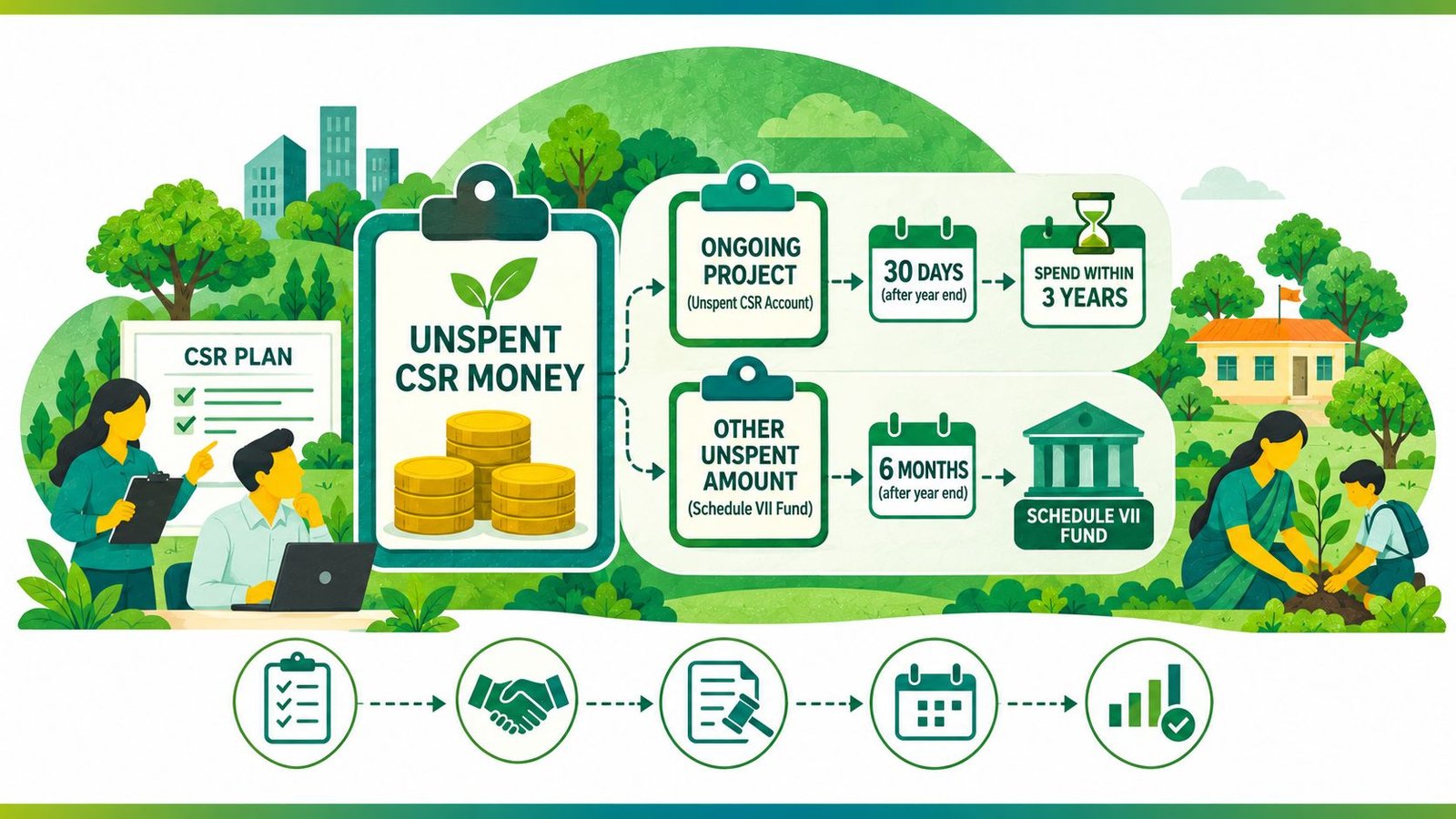
The financial year is about to close, one CSR project started late, and an implementing partner has used only part of the money released to it. Under Section 135 of the Companies Act, 2013, the unspent CSR amount from an ongoing project must move into an Unspent CSR Account in a scheduled bank within 30 days of the year end, and any other unspent amount must go to a fund listed in Schedule VII within six months.
Money in the Unspent CSR Account then has three financial years to be spent before it, too, goes to a Schedule VII fund. Missing any of these deadlines is a civil wrong, penalised at both company and officer level.
Covered below: the two routes, a year-end check that keeps the unspent amount small, the ongoing project test, penalties, carry forward, and a proposed change to the 30-day deadline.
What happens to unspent CSR money? Two routes, two deadlines
The route depends on one question: does the unspent amount belong to an ongoing project? The Ministry of Corporate Affairs (MCA) sets out both tracks in its FAQs on CSR (General Circular No. 14/2021). Either way, the board's report must give the reasons for not spending.
| Unspent amount from an ongoing project | Any other unspent amount | |
|---|---|---|
| Where it goes | The Unspent CSR Account: a special account the company opens for that financial year in a scheduled bank | A fund listed in Schedule VII of the Act |
| Deadline | Within 30 days of the end of the financial year (30 April, for a year ending 31 March) | Within six months of the end of the financial year (30 September, for a year ending 31 March) |
| What happens next | Must be spent within three financial years from the date of transfer. Anything still unspent then goes to a Schedule VII fund within 30 days of the end of the third year. | The transfer is treated as meeting the obligation under Section 135(5), with disclosure in the board's report and the annual report on CSR. |
| Legal basis | Section 135(6) | Second proviso to Section 135(5) |
Two details are easy to miss. First, the six months are not extra time to spend: MCA's FAQ 7.3 states that an unspent amount not tied to an ongoing project cannot be spent on any CSR activity during that period and must go to the fund. Second, until a dedicated fund is notified, Rule 10 of the CSR Rules allows the transfer to any fund included in Schedule VII.
How to keep the unspent CSR amount small: a year-end check
Whether money ends up unspent is largely settled well before 31 March: by when projects are approved, when work orders go out and when funds are released.
- Approve the annual action plan early. Under Rule 5(2) of the CSR Rules, the CSR Committee recommends a plan covering the projects, how they will be executed and the schedule for using the funds. A plan approved late leaves little time to spend.
- Classify every project when it is approved: ongoing (multi-year) or within the year. For ongoing projects, record the timeline and the year-wise allocation, which Rule 4(6) asks the board to monitor.
- Issue the work order or award the contract for any multi-year project before 31 March. Under FAQ 6.2, a project has commenced only at that point, and FAQ 6.1 says it must commence within the financial year to be treated as ongoing.
- Release funds in tranches the partner can use within the year, tied to milestones. FAQ 7.4 asks the CSR Committee and the board to disburse so that funds can be utilised during the financial year. Partner capacity matters here, and our article on selecting an NGO partner for CSR covers how to check it.
- Ask partners for utilisation figures, not only receipts, from the third quarter onwards. Under Rule 4(5), the board must be satisfied that funds were used as approved, and the Chief Financial Officer (or the person responsible for financial management) certifies this. Regular CSR monitoring and evaluation produces that evidence.
- Estimate the likely unspent amount in February and sort it into ongoing and other. That leaves time to open the bank account and draft the reasons for the board's report.
- Put the deadlines in the compliance calendar: 30 April for the Unspent CSR Account, 30 September for Schedule VII transfers, and the end of the third financial year for money already in the account.
What is an Unspent CSR Account, and how does it work?
An Unspent CSR Account is a special bank account that holds the unspent amount of CSR tied to ongoing projects. Section 135(6) requires the company to open it for the specific financial year, in any scheduled bank, under the name "Unspent Corporate Social Responsibility Account".
One account per year is enough for all of that year's ongoing projects. MCA's FAQ 7.5 confirms that a separate account is needed for each financial year, not for each project. Several banks offer current accounts set up for this purpose, sometimes listed as a CSR unspent account.
The money is ring-fenced. Under FAQ 7.6 it can be used only for the expenses of ongoing projects, and the account cannot be used as collateral, to create a charge, or for any other business activity.
Surplus can also end up here. MCA's FAQ 3.4 describes surplus as income generated from CSR spending, such as interest an implementing agency earns on CSR funds. Under Rule 7(2), it goes back into the same project, into the Unspent CSR Account, or to a Schedule VII fund within six months of the year end.
What counts as an ongoing project under CSR rules?
The first route is open only to ongoing projects, so the definition decides where the money goes. Rule 2(1)(i) of the Companies (CSR Policy) Rules, 2014, as amended in 2021, defines an ongoing project as a multi-year project with a timeline of not more than three years, excluding the financial year in which it started. It also includes a project first approved for one year whose duration the board later extends beyond one year with reasonable justification.
The evidence sits in three documents: the board approval, the work order or contract, and a project plan with start and end dates and a year-wise allocation. FAQ 6.1 describes the intent as covering projects with identifiable start and completion dates.
The timeline cannot be stretched: FAQ 6.3 rules out any extension beyond the permissible period. Under FAQ 6.6, the board may modify or abandon an ongoing project only in exceptional circumstances, on the CSR Committee's recommendation and with reasonable justification.
What is the penalty for not transferring unspent CSR?
Section 135(7) sets a penalty for failing to comply with Section 135(5) or 135(6), and MCA's FAQ 8.1 describes the failure as a civil wrong. The penalty applies at two levels.
| Who | Penalty under Section 135(7) |
|---|---|
| The company | Twice the amount it was required to transfer to the Schedule VII fund or the Unspent CSR Account, or ₹1 crore, whichever is less |
| Every officer of the company who is in default | One-tenth of that amount, or ₹2 lakh, whichever is less |
Paying the penalty does not settle the obligation. MCA's FAQ 8.2 states that the penalty is over and above the amount the company must still transfer under Section 135(5) or 135(6).
The transfers are also checked from outside. Under paragraph 3(xx) of the Companies (Auditor's Report) Order, 2020, the statutory auditor reports whether unspent amounts reached a Schedule VII fund within six months and the Unspent CSR Account within 30 days. Since the 2022 amendment to the CSR Rules, the annual report on CSR also shows, for the preceding three years, the amounts transferred to the account and the balance still in it. Our page on CSR legal requirements in India covers the rest of the compliance framework.
Can CSR money be carried forward?
Only in one direction. Outside the ongoing-project route, a shortfall cannot be added to next year's spending; it must go to a Schedule VII fund. An excess can be carried forward as a set-off, within limits.
| Situation | What the law allows | Conditions |
|---|---|---|
| Spent less than required, on an ongoing project | Hold the amount in the Unspent CSR Account for up to three financial years | Use it only for ongoing projects; then transfer any balance to a Schedule VII fund |
| Spent less than required, any other case | No carry forward | Transfer to a Schedule VII fund within six months |
| Spent more than required | Set off the excess against the requirement of up to the next three financial years (Section 135(5), third proviso; Rule 7(3)) | The board passes a resolution; the excess cannot include surplus from CSR activities; any excess not set off within that period lapses (FAQ 3.8) |
In practice, CSR carry forward of an excess is a planning tool, not a correction for a shortfall. Our explainer on the 2% CSR rule shows how the yearly obligation is worked out.
Does a company with an Unspent CSR Account need a CSR Committee?
Under Section 135(9), when the amount a company must spend is ₹50 lakh or less, the board performs the CSR Committee's functions and no committee is required. A proviso added to Rule 3(1) of the CSR Rules in September 2022 (G.S.R. 715(E)) adds a condition: a company with any amount in its Unspent CSR Account must constitute a CSR Committee and comply with Section 135(2) to (6).
A company that relies on Section 135(9) but still holds money in the account should confirm its position with its company secretary.
What may change: the 90-day proposal in the Corporate Laws (Amendment) Bill, 2026
Clause 43 of the Corporate Laws (Amendment) Bill, 2026, introduced in the Lok Sabha on 23 March 2026, proposes to extend the deadline for moving an ongoing project's unspent amount into the Unspent CSR Account from 30 days to 90 days after the year end. The same clause proposes raising the net-profit threshold in Section 135(1) from ₹5 crore to ₹10 crore, and the Section 135(9) limit from ₹50 lakh to ₹1 crore.
A Joint Parliamentary Committee presented its report on the Bill on 3 August 2026. As of 4 November 2026, PRS Legislative Research does not show the Bill as passed, so the 30-day deadline in Section 135(6) still applies. Year-end plans should assume 30 days until the change is passed and notified.
One year end, three projects: an illustrative case
A composite case, built to show how the rules play out at a year end. It is not based on any single company.
A manufacturing company approved three CSR projects for the year. In mid-March, its CSR Committee reviewed where each one stood.
| Project | Position on 31 March | Route for the unspent amount |
|---|---|---|
| A. Classroom and laboratory upgrade in four government schools, approved as a two-year project | Contract awarded in January; work under way | Ongoing: Unspent CSR Account by 30 April, spent over the rest of the project |
| B. Health camps in villages near the plant, approved for one year | Partner not yet appointed; no work order issued | Not ongoing: Schedule VII fund by 30 September. It cannot be spent on the camps in the meantime (FAQ 7.3). |
| C. Livelihood training through an NGO, approved for one year | Funds released in February; the partner had used about half | The unused half is not spent (FAQ 7.4). Not ongoing: Schedule VII fund by 30 September. |
The next year, the company approved its annual action plan in the first quarter and classified each project at approval. Work orders for multi-year projects went out by the third quarter, and funds were released in quarterly tranches against utilisation reports. With outside CSR project management support, a February review sized the likely unspent amount in time to act on it.
FAQs
What is the deadline for the unspent CSR amount to be transferred to the Unspent CSR Account?▾
Within 30 days of the end of the financial year (30 April, for a year ending 31 March), under Section 135(6). The Corporate Laws (Amendment) Bill, 2026 proposes 90 days, but that is not yet law.
Does money given to an NGO count as CSR spent?▾
Only once the implementing agency uses it. MCA's FAQ 7.4 says mere disbursal does not amount to spending, and Rule 4(5) requires the board to be satisfied that funds were used as approved, with the Chief Financial Officer (or the person responsible for financial management) certifying this.
What happens if money in the Unspent CSR Account is not spent within three years?▾
The company must transfer the balance to a Schedule VII fund within 30 days of the end of the third financial year, under Section 135(6). Missing that transfer attracts the penalty in Section 135(7).
Can money in the Unspent CSR Account be used for a different ongoing project?▾
The FAQs do not answer this directly. FAQ 7.6 limits the account to the expenses of ongoing projects, and FAQ 6.7 allows a project's budget to be used for another project if the board and CSR Committee record the change. Confirm the treatment with your company secretary before moving money between projects.
Which funds count as Schedule VII funds for unspent CSR?▾
MCA's FAQ 3.15 lists the Swachh Bharat Kosh, the Clean Ganga Fund, the Prime Minister's National Relief Fund, the PM CARES Fund, and other funds the Central Government sets up and MCA notifies for the welfare of Scheduled Castes, Scheduled Tribes, other backward classes, minorities and women. Funds not named in Schedule VII do not count (FAQ 3.16).
The bottom line
The unspent amount of CSR is decided during the year, not at its end. Once the year closes, the rules leave little room: 30 days, six months, three years. A company that classifies projects at approval and tracks utilisation rather than disbursal leaves itself less to transfer, and a clear record of why when it does.
References
- Companies Act, 2013, Section 135 (Corporate Social Responsibility), as amended.
- Ministry of Corporate Affairs. Companies (Corporate Social Responsibility Policy) Amendment Rules, 2021, G.S.R. 40(E), 22 January 2021. mca.gov.in/Ministry/pdf/CSRAmendmentRules_22012021.pdf
- Ministry of Corporate Affairs. Companies (Corporate Social Responsibility Policy) Amendment Rules, 2022, G.S.R. 715(E), 20 September 2022.
- Ministry of Corporate Affairs. General Circular No. 14/2021, Frequently Asked Questions on Corporate Social Responsibility, 25 August 2021.
- Ministry of Corporate Affairs. Companies (Auditor's Report) Order, 2020, paragraph 3(xx).
- The Corporate Laws (Amendment) Bill, 2026 (Bill No. 85 of 2026), clause 43. Status: PRS Legislative Research, prsindia.org/billtrack/the-corporate-laws-amendment-bill-2026